Emissions reduction plan
Introduction
This Emissions Reduction Plan sets out how we will do our part to actively reduce greenhouse gas emissions from our operations and to contribute to New Zealand’s national target of net zero by 2050.
Our emissions are produced from operations we carry out as part of our core functions such as solid waste collection and disposal, water treatment, wastewater treatment and operating facilities like swimming pools and libraries. We also own substantial forestry land, which is a carbon sink. As the trees grow, they extract carbon from the atmosphere and reduce overall greenhouse gases. In our last Greenhouse Gas Inventory (2022), our forest plantations fully offset our emissions for that year, which is a unique position for a district council.
Despite our unique position, we recognise that we need to do more and we have set emissions reduction targets to help New Zealand get towards net zero by 2050.
We have several actions already underway that are showing positive results. We also have more planned actions and investments, with funding approved in our 10-year plan, which are expected to reduce our emissions by 23,000 tonnes of CO2-e per year.
The Emissions Reduction Plan will not only ensure that we meet our emissions reduction targets for the next 10–20 years but will also save ratepayers money over the life of these investments.
Our plan to reduce emissions
The drop-down section looks at our key emissions sources and sinks, and what we're doing to reduce our emissions.
Solid waste disposal (Broadlands Landfill)
Source of emissions:
- 25,600 tonnes of CO2 equivalent in 2022.
- 87% of total emissions (before forestry offsets).
- Classified as Scope 1 emissions in the GHG Inventory.
- Under the Emissions Trading Scheme (ETS), Council is required to surrender carbon credits for the emissions associated with waste disposed at the Broadlands landfill, which costs around $1.8 million a year at (2022) prices.
- Council organises rubbish and recycling collection in urban areas, manages waste transfer stations in our smaller towns, and disposes of most of the district’s rubbish and waste at the Broadlands landfill in Taupō.
- Organic waste (such as food scraps, wood, paper and cardboard, and green waste) releases greenhouse gases as it decomposes that contributes to climate change.
What are we doing to reduce our emissions:
- Measuring, recording and monitoring emissions annually in our Greenhouse Gas Inventory.
- Our Long-term plan 2024–2034 allocates $7.8 million to install a gas flare and to build a covered area for the separation and storage of construction and demolition waste in 2025/26–2027/28. We cannot do this earlier because we need to secure our landfill resource consent renewal in 2027. A gas capture and flaring system has the potential to reduce landfill emissions by around 60% compared to 2019 base year (based on MfE’s August 2022, emission factors). That is a reduction in annual emissions of around 23,000 tonnes of CO2-e. The financial savings for ratepayers are also significant, with the reduced cost of buying carbon credits of around $1.8 million a year at 2022 prices.
- Continue diverting green waste and recycling from the landfill, and waste reduction measures focusing on organic waste like food waste, green and garden waste, and wood construction materials have the potential to further reduce emissions. In 2023/2024, we diverted 19,121 tonnes of waste from the landfill or around 41% of total landfilled waste.
- Our Long-Term Plan funds educational programs to empower our community to reduce emissions by increasing awareness and fostering sustainable behaviour. We organise several workshops that, directly or indirectly, reduce emissions including our Home Composting workshop, our popular Repair Café and offer grants of up to $2,000 for projects that reduce waste generation, promote reuse and recovery of materials, and divert waste from landfills through recycling and composting initiatives, and a subsidy of $100 when buying a worm farm and home composting units.
Wastewater Treatment & Disposal
Source of emissions:
- 1,300 tonnes of CO2 equivalent.
- 4% of total emissions (before forestry offsets).
- Classified as Scope 1 emissions in the GHG Inventory.
- For most urban areas when you flush the toilet, pull the plug from a sink, or have a shower, Council collects, processes and disposes of the wastewater. Wastewater is also generated from commercial and industrial premises.
- Wastewater includes organic matter such as human waste, food scraps, fats, oil and grease, and other debris such as sand, grit and plastic. The organic material, including human waste, releases greenhouse gases as it decomposes. The decomposing process, including the microbes involved and level of air, determines the amount of greenhouse gases produced.
What are we doing to reduce our emissions:
- Measuring, recording and monitoring emissions annually in our Greenhouse Gas Inventory.
- Continue to vermi-compost (worm farm) biosolids from wastewater treatment, which we’ve been doing for the past 8 years.Gas flaring (methane) at our largest (Taupō) wastewater treatment plant.
- Gas flaring (methane) at our largest (Taupō) wastewater treatment plant.
Electricity use
Source of emissions:
- 1,700 tonnes of CO2 equivalent.
- 6% of total emissions (excluding forestry).
- Classified as Scope 2 emissions in the GHG Inventory.
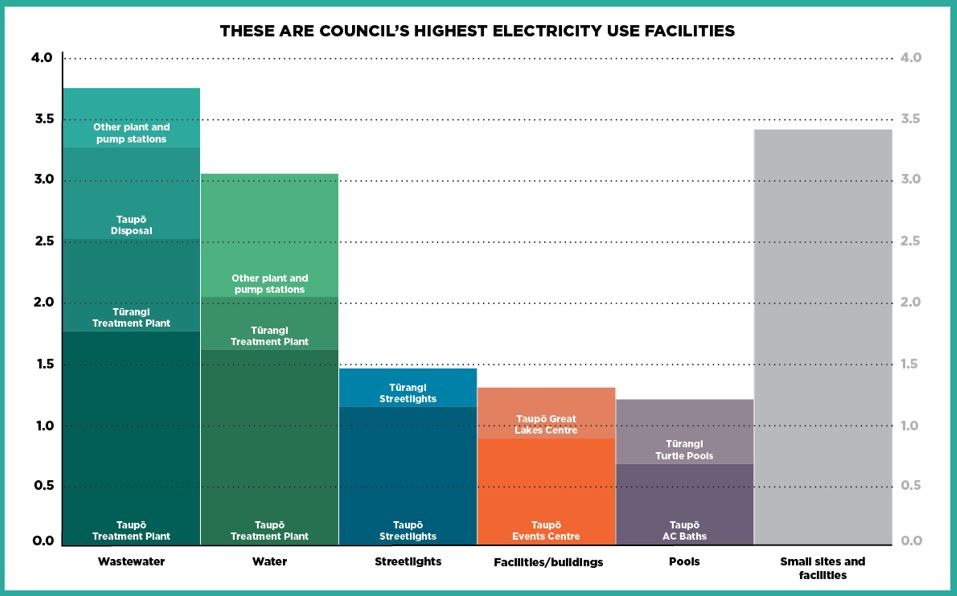
- Council uses significant electricity from national generation for treating water and wastewater; providing street lighting; and heating buildings and community facilities like libraries, event centres, pools, and council administration buildings. Council’s electricity use is equivalent to that used by around 1,800 households. Although 85% of New Zealand’s electricity is generated from renewable sources, there are still considerable emissions associated with it. New Zealand is aiming to produce 100% of its electricity by 2030.
- Council has some control over its electricity use. However, substantial electricity usage relates to the operation of water and wastewater treatment plants which are critical for public health and wellbeing, as shown in the Figure below. There is some, but limited scope to reduce electricity use from these plants, or to shift electricity use to off-peak times when New Zealand’s electricity is mostly renewable or low emission.
What are we doing to reduce our emissions:
- Measuring, recording and monitoring emissions annually in our Greenhouse Gas Inventory.
- We have switched all our streetlights to LEDs.
- Switched to more off-peak pumping at our largest electricity use site (Taupō wastewater treatment plant).
- An enabling District Plan (building and development rules) which supports and provides for renewable energy generation such as geothermal, hydro and solar power generation.
Vehicle fleet and gardening operations
Source of emissions
- 610 tonnes of CO2 equivalent.
- 2% of total emissions (before forestry offsets).
- Classified as Scope 1 emissions in the GHG Inventory.
- We have vehicles to get staff around the district to do their job, and utes and trucks for moving and towing equipment. We also use diesel mowing and garden maintenance equipment.
- As at 2023, Council had a fleet of 161 mostly petrol and diesel vehicles, made up of 52 cars, 88 utes, 12 vans and 9 trucks.
What are we doing to reduce our emissions
- Measuring, recording and monitoring emissions annually in our Greenhouse Gas Inventory.
- We are implementing a fleet policy that will shift all council vehicles to hybrid and electric over time, which reduces emissions from the burning of fuel and will also save money over time from the reduction in fuel costs. We have substituted most of our petrol fleet to petrol-hybrids from 58 petrol vehicles in 2019 to 29 vehicles in 2023 and aiming for zero petrol vehicles by 2025. This shift has resulted in reduced emissions in our last inventory.
- We plan to continue substituting our diesel vehicles to hybrids or electric vehicles aiming for 100% hybrid or EV fleet by 2040.
Other emissions from Council operations
Other emissions from Council operations includes refrigerants, heating fuels and air travel
Source of emissions:
- 260 tonnes of CO2 equivalent.
- 1% of total emissions (before forestry offsets)
- Classified as Scope 1 (heating fuels and refrigerants) and Scope 3 (air travel) emissions in the GHG Inventory.
- Council is responsible for a small amount of other emissions associated with its operations, from refrigerants, LPG, natural gas, air travel and accommodation of staff when attending business trips outside Taupō district.
What are we doing to reduce our emissions:
- Measuring, recording and monitoring emissions annually in our Greenhouse Gas Inventory.
- We have low emissions in this space and do not operate highly polluting machinery or equipment like coal-fired boilers.
- Our largest pool (AC Baths) is geothermally heated.
- Tūrangi pool is heated by a heat pump system while the pool in Mangakino is unheated.
- Council minimises car or air travel and attends digitally, where feasible.
Embodied emissions from construction
Source of emissions:
- Quantity unknown.
- Scope 3 emissions not currently captured in the GHG Inventory.
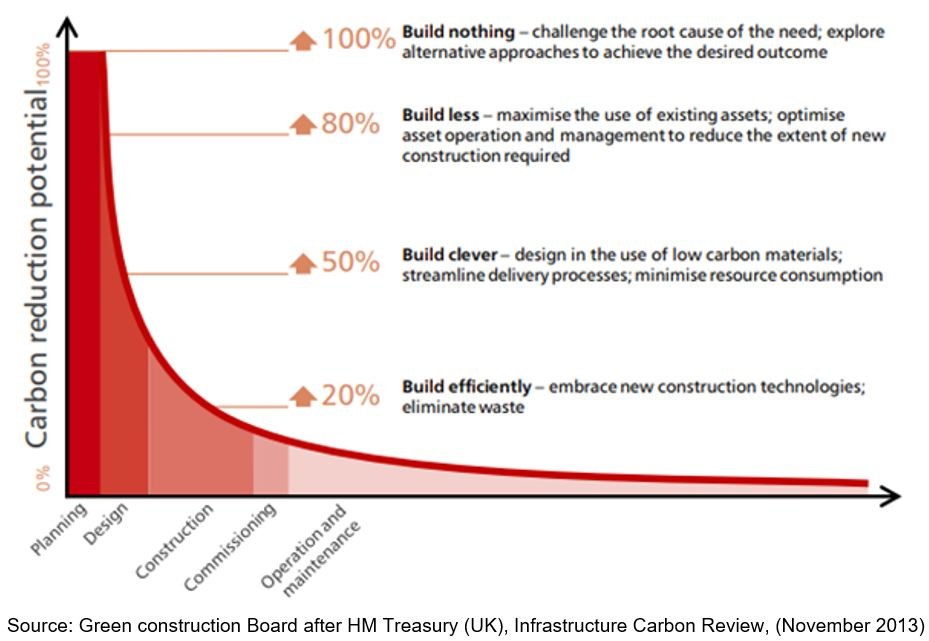
- The building and construction sector is a large contributor to greenhouse gas emissions from the production of building materials and construction. Council builds and renews a significant amount of infrastructure each year. By its nature this infrastructure for example water reservoirs, or new roads, uses a lot of concrete, steel, bitumen, and other materials that require a lot of energy to make and hence produced substantial emissions (known as embodied emissions). However, this sector has large emission reduction potential if we approach it in a clever way as shown in the Figure below.
What are we doing to reduce our emissions:
- These are not currently measured and monitored in emissions inventory.
- We will get advice on the feasibility of including these emissions in future inventories.
- Our procurement policy provides for consideration of broader outcomes when purchasing goods, services or works. These broader outcomes include supporting the transition to a net zero emissions economy and assist the Government to meet its goal of significant reduction in waste.
Responsible and sustainable financial investments
Source of emissions:
- Quantity unknown.
- Scope 3 emissions sink.
- Council holds significant financial investments with the largest financial holding being the TEL fund at around $70.6 million in 2024*.
*Note the TEL fund was established after Taupō Electricity Limited (TEL) and Taupō Generation Limited (TGL) were sold in 1995. TEL fund amount as in Taupō Council Annual Report 2022/33. Balance of TEL Investment as at 30 June 2023.
What are we doing to reduce our emissions:
- Any emissions, or carbon offsets or sinks from our investments are not currently measured or monitored in our emissions inventory.
- The TEL fund is professionally managed with a requirement that the managers:
- work towards aligning the portfolio with net zero emissions by 2050 or sooner.
- exclude investment in companies involved in the extraction of oil sands and thermal coal, or the extraction, production and refining of oil & gas.
- intentionally increase investment in companies, products, or securities that provide solutions for climate change when that aligns with other investment requirements.
Forestry and planting to offset emissions
Source of emissions:
- Forestry plantations offset 30,000 tonnes of CO2 equivalent.
- 105% of total emissions i.e. offsetting all our emissions
- Planting forests act as a carbon sink (biogenic carbon removals) and these are reported in the GHG Inventory. We own significant forestry holdings of around 850 hectares. When accounting for these forestry sinks, the Inventory shows that these would fully offset our emissions in 2022.
- Council owns and manages a significant number of reserves of both grassland and native trees and bush. These are not currently captured in our inventory.
What are we doing to reduce our emissions:
- Measuring, recording and monitoring emissions annually in our Greenhouse Gas Inventory.
- We have around 850 hectares of forests and an annual planting programme of pinus radiata to replace harvested trees. Council-owned forests are located in Rangitaiki, Tirohanga, Tūrangi and Omori with a mix of young trees (<10 years) and older ones (30+ years). We plan to maintain this hectarage of forestry for the foreseeable future.
- We provide funding through our Community Grants and Partnership Agreements to support local volunteer groups who undertake native planting initiatives.
Providing low emission transport options to our community
Source of emissions:
- Not part of council emissions.
- We recognise that road transport is a major source of emissions (as well as air pollution) in our district. Council has the responsibility for providing the road network but has limited influence on how, or how much, people choose to travel. Council provides quality walking and cycling networks, and public transport (bus) services to give people an alternative to driving.
What are we doing to reduce our emissions:
- These emissions are not part of our inventory because they are attributable to individuals rather than being a source of emissions from council’s operations.
- However, as part of our roading functions, we built extensive walking and cycling networks in our urban areas and are planning a $14.9 million programme of improvement works over the next 10 years including: new shared pathways and footpath connections, improved footpath lighting, new urban cycle lanes and more cycle racks and pedestrian crossing improvements.
- We provide regular public transport (bus) services to give people an alternative to driving.
- We support cycling training and education in our schools, in partnership with community and volunteer groups.
Impact of our Emissions Reduction Plan
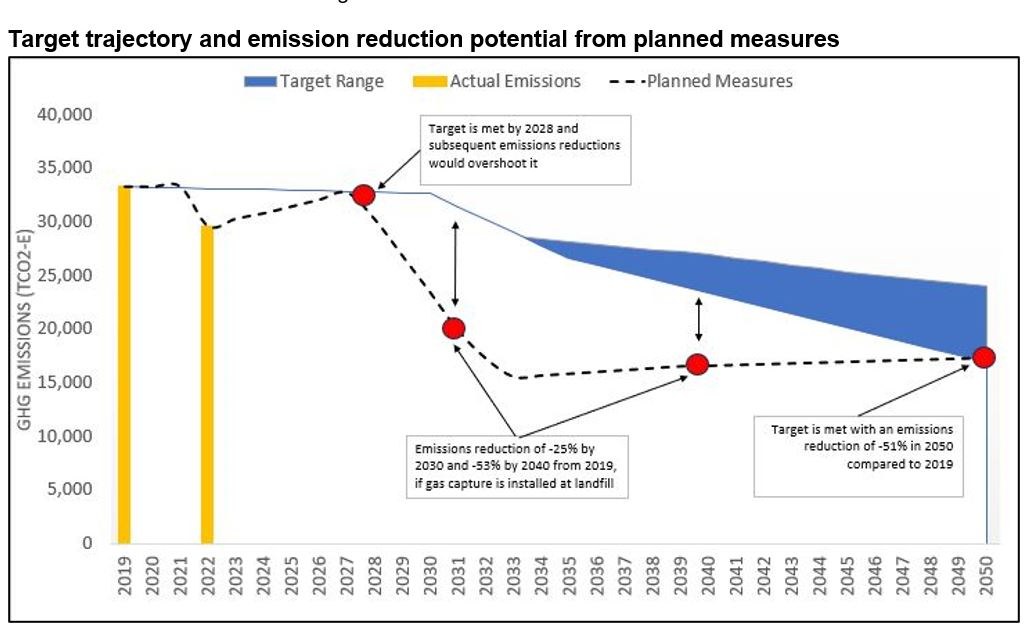
Our planned and funded actions in our 10-year planning horizon will enable us to continue to meet our emissions reduction targets. The biggest change will be when a gas capture and flare system is installed at our landfill and becomes operational (planned for 2027/28), as shown in the Figure below. The emissions reduced from this investment will significantly exceed our targets for some time.
Future long-term plans will identify further actions and investment for the period beyond 2034 to ensure we continue to meet our targets.
The emissions reduction trajectory assumes that our substantive planned measures will be fully implemented within the set timeframes, as follows:
- Gas capture and flaring equipment is installed at the Broadlands landfill with installation work beginning in 2026/27
- Council’s vehicle fleet will continue to be gradually substituted to hybrid and electric vehicles between 2025-2040
- Energy efficiency improvements will result in a gradual reduction in electricity used by Council of 10% between 2025-2034
- Forestry holdings will be maintained at their current hectarage for at least the next 10 years (not reflected in the chart).