Emissions from council operations are produced from several sources, with waste disposed at the Broadlands Road Landfill being the largest source of emissions.
Alongside this, many of our everyday council activities generate some greenhouse gas emissions.
- We operate extensive infrastructure, including street lights, large community facilities and venues, and water treatment plants, which use a lot of electricity.
- Our wastewater treatment processing also produce substantial emissions.
- We operate a fleet of vehicles and a range of gardening equipment to maintain our parks and reserves.
- We build and renew a significant amount of infrastructure each year which generate emissions through construction and material use.
Council owns plantation forestry across Rangitaiki, Tirohanga, Tūrangi and Omori which act as an important carbon sink by absorbing and storing biogenic carbon as trees grow. Although Council harvests a portion of these forests on a rotational basis (every three years), which results in carbon being released from the forest carbon pool.
These operational emissions sources and sinks are recorded in our Greenhouse Gas Emissions Inventory, which is independently verified and produced every year. Our current and historic GHG Inventories can be downloaded from the following links:
Taupō District Council baseline emissions inventory 2018/19 (PDF, 1MB)
Taupō District Council baseline emissions inventory 2021/22 (PDF, 1MB)
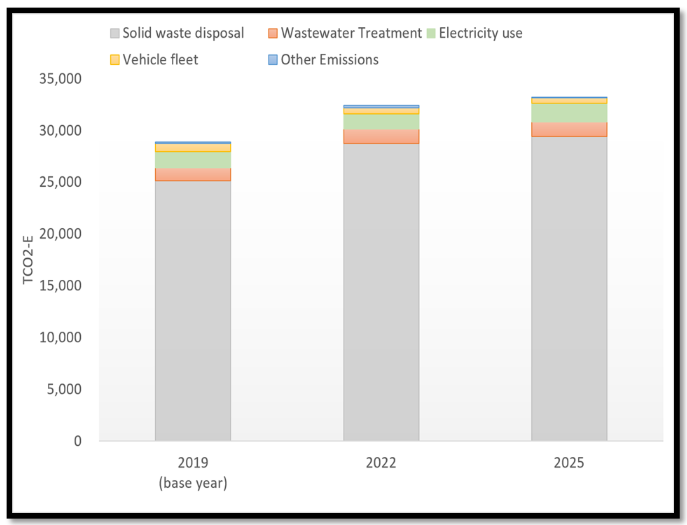
The GHG Inventory shows that our emissions have steadily increased from FY18/19 as shown in the chart below. Landfill waste is the dominant source of emissions across all years, with comparatively smaller contributions from wastewater treatment, electricity use, petrol and diesel, and other sources.
Although it may appear that no progress has been made, the increase in emissions in FY24/25 compared with FY18/19 comes on the back of rapid population growth and economic recovery from the Covid pandemic. Both contributed to an increase in the total volume of waste being disposed. However, emissions would have been higher if we had not taken action to reduce or divert waste from the landfill.