

Our options
About the options
The Government has made it clear that the status quo is not an option.
Local Water Done Well will significantly change the way water services are delivered in New Zealand, and will impact generations to come.
The Government’s stated position for councils is:
“To work together on joint water services arrangements where it makes sense to support financial sustainability, ease upward pressure on rates and provide for new infrastructure to support housing growth.”
We want what is best for Taupō District. We have done a lot of work and analysis, obtained expert advice and undertaken the due diligence needed to understand our options for water services delivery. We have narrowed down the realistic options for Taupō District to the three outlined below, with a summary of all options in the pdf document and more detailed information for each option below.
We want to know what our communities’ priorities are for water so we can take those into account as we make this significant decision.
Options overview
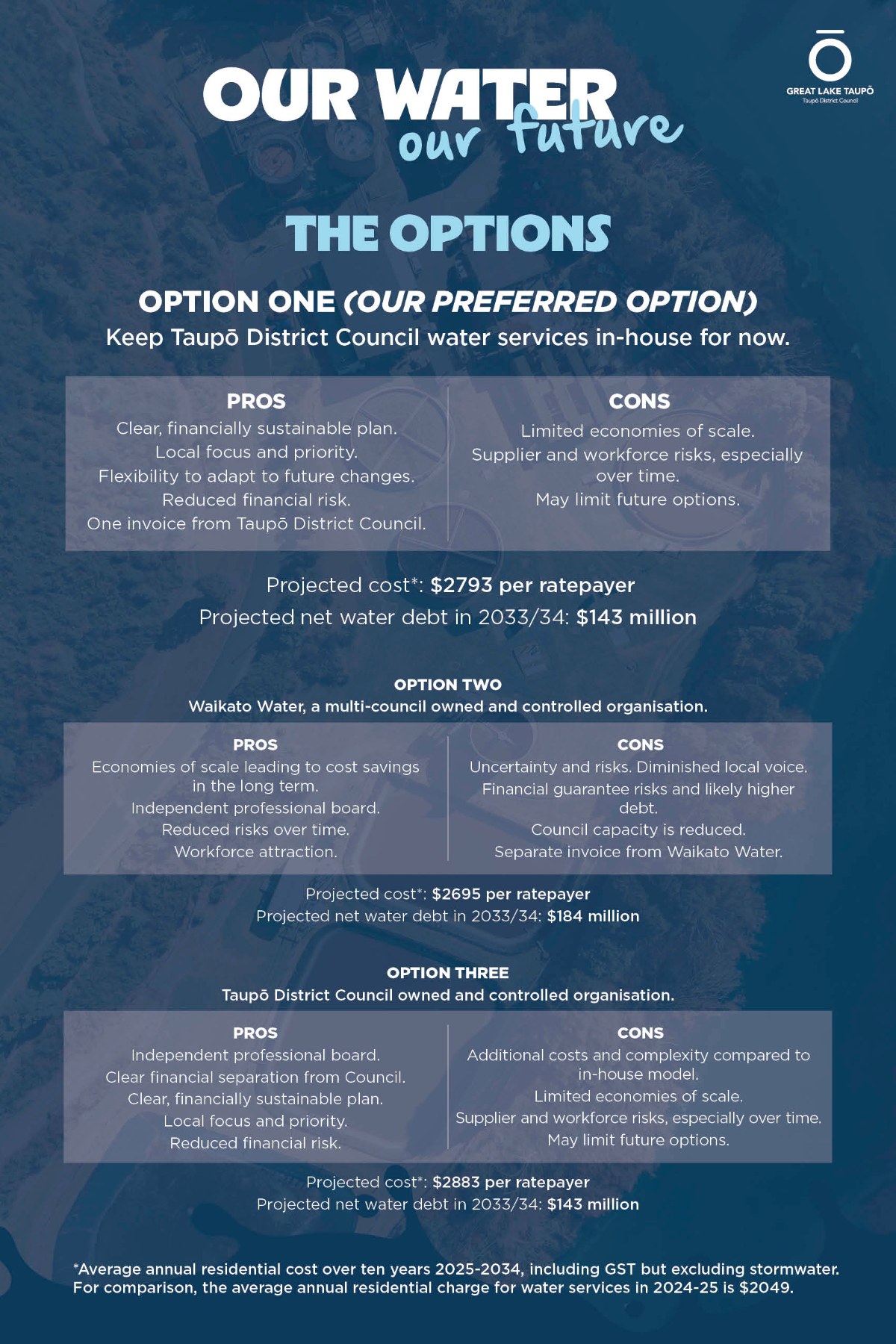

Option One: Keep water services in-house for now (preferred option)
Council continues to deliver water services with some changes to ensure compliance with Local Water Done Well legislation. This is our preferred option because we believe this offers the best value for our ratepayers in the short to medium term.
Summary
This approach allows the council to retain local control and accountability, ensuring decisions are made with the community's best interests in mind. It allows us to continue delivering water services in the short to medium term while keeping open the option to join a larger regional water entity at a later date. In the meantime Council’s strong financial position keeps our debt burden low.
It is the lowest risk option at present. It allows us to take a measured approach to water reform and review our position. However, this option would not deliver the long-term benefits promised by a regional water entity (option 2) or mitigate any supplier or workforce risks.
What it would look like
Council continues to deliver water services, with some changes to ensure compliance with Local Water Done Well legislation (such as financial separation). Council continues to own and control all its water assets and make all decisions relating to water services. It will also retain its water-related debt. Within two years we will review the situation to ensure that this remains the most advantageous option.
To support our goal of exploring benefits that could be obtained through collaboration opportunities, we propose joining Waikato Water as a shareholder in a limited capacity. Our shareholding would be limited to procurement and some shared services. We are still working through the details; but we would only proceed if we believed that the benefits outweighed the costs. This approach safeguards our options and gives us some influence on the development of the Waikato Water entity for our potential future benefit.
How will you pay
Water users will continue to receive one Council rates bill, with water and wastewater charges showing as separate line items. Longer-term, expect water metering and water charging based on the amount of water you use.
Potential pros
- Clear, financially sustainable plan: We have a well-defined plan to continue delivering high-quality water services to our community. We have shown this plan will meet the government’s financial sustainability measures. Our plan keeps the burden of debt relatively low.
- Local focus and knowledge: We continue to own our water assets. With a local focus, we can prioritise projects and allocate resources based on our community's unique needs, leveraging local knowledge and resources.
- Flexibility to adapt to future changes: We can retain our water services and take a wait and see approach to water reform. We could still switch to a different delivery model in future if the advantages outweigh the disadvantages.
- Reduced financial risk: We avoid taking on financial guarantees for other districts' investment requirements, protecting our community's interests.
- Retain local accountability: Our elected councillors remain accountable to the community for water services decisions.
- Lower cost implementation: Because Council is already providing water services, this approach minimises implementation costs and risks, reducing the financial burden on our community.
- Balanced infrastructure investment: We can prioritise infrastructure investments based on need, balancing rates affordability with essential projects, and deferring more discretionary spending.
Potential cons
- Limited economies of scale: Our current water services operation may not benefit from economies of scale, potentially limiting opportunities for cost savings.
- Ongoing supplier and workforce risks: While Taupō District remains an attractive place to live and work, we still face risks related to supplier reliability and workforce recruitment and retention. This risk may increase if larger water service entities emerge around us.
- Risk of under-investment: Ratepayer pressure to keep costs down may lead to under-investment in our water services, potentially compromising their quality. However, regulation by the Commerce Commission may help mitigate this risk.
- Compromised outcomes: With Council resources spread across many services, our focus and capacity to deliver high-quality water services may be compromised.
- Limited future options: It may be harder for Taupō to join Waikato Water at a later date if we change our minds or find the costs of going it alone become unsustainable.
Why this is our preferred option
Weighing up all the information available, we believe the best option at present is to keep water services in-house with Taupō District Council and review this position within two years. With so much uncertainty, we do not believe that the potential benefits of moving to a different model currently outweigh the potential risks.
Taupō’s relatively strong position gives us the flexibility to cautiously navigate water reform. Our preferred option of an in-house council business unit is the lowest-risk and simplest option and demonstrates sufficient investment and revenue that will deliver good outcomes for our communities.
We could consider becoming a full shareholder joining a larger entity, such as Waikato Water, at a later date if that becomes an attractive and compelling option. We would talk to our community again before committing to this.
Option Two: Join Waikato Water, a regional water entity
Taupō District Council partners with neighbouring councils in the Waikato region to form a multi council-owned and controlled water services organisation. Assets, debt, and responsibility for delivering water services would be transferred to this organisation within five years.
Summary
This regional approach aims to achieve economies of scale, reduce long-term costs and risks, and improve service delivery. Our local priorities would need to be balanced against the priorities across the whole region. This approach has more initial risk, but over the long-term, Waikato Water could become a compelling option.
What it would look like
Taupō District Council partners with neighbouring councils in the Waikato region to form a multi council-owned and controlled water services organisation. Our local water assets will be transferred to it within five years. This entity, Waikato Water, will be responsible for delivering water services to our community.
Waikato Water would be owned by its shareholding councils and employ staff to deliver water services across the various districts they serve. Council would be a shareholder, with a share likely to be around 30 per cent based on prospective partners and our number of water and wastewater connections. As a shareholder, Taupō District Council will have a role in providing strategic direction and oversight. The six other councils exploring this option are Hauraki, Matamata-Piako, Ōtorohanga, South Waikato, Waipa and Waitomo.
How will you pay
Water users will receive a separate bill for drinking and wastewater services, rather than in their rates. Longer-term, expect water metering and water charging based on the amount of water you use. Stormwater would remain with Taupō District Council.
Find out more about Waikato Water Done Well
Potential pros
- Economies of scale: A regional water entity would benefit from scale efficiencies, reducing costs and improving service delivery. In the long term this will lead to cost savings.
- Reduced risks over time: By spreading risks and costs across a larger base, we can decrease our risks over time. A larger entity can also invest in technology, workforce development and other improvements, further reducing risks.
- Independent governance: A professional board, separate from Council governance, would oversee water infrastructure decisions, shielding them from political influence and ensuring expertise-driven decision-making. The risk of under-investment should be reduced, as directors of a water focused entity will ensure asset management and compliance are key priorities.
- Council focus: With Waikato Waters handling water services, Taupō District Council would be free to focus on and invest in other priorities.
- Workforce attraction: A large entity with a sole focus on water may achieve better outcomes, attract greater talent, and allow for job specialisation.
Potential cons
- Financial guarantee risks: Council would need to provide a financial guarantee to the new organisation, which could limit our ability to borrow for other priorities. The new organisation is likely to have higher debt than Council’s existing financial strategy.
- Diminished local voice: Council would lose control of its assets and projects would be prioritised across the region rather than our district. Taupō District’s local views will be one perspective amongst many partners.
- Uncertainty and risks: Considerable work is still to be done to establish Waikato Waters, including the negotiation of shareholder agreements, asset transfer arrangements and establishment costs.
- Separate pricing: Water charges and Council rates would be set by separate entities and there would be no balancing of overall rates and water costs being charged to the community.
- Reduced council viability and capability: Taupō District Council already shares services across its operations. Removing waters will increase the cost burden for our other operations.
- Establishment costs: Higher implementation costs in the short term than either of the other options, although these costs will be funded through debt, and are projected to be recouped over time by the entity’s efficiency improvements.
- Limited future options: It would be difficult to exit Waikato Water at a later date if we change our minds or find the costs of being involved become unsustainable.
Other
- Debt Capacity: One of the benefits of any council-controlled organisation model is the ability to access additional debt. Taupō District Council does not have debt capacity challenges and so this benefit does not apply in our context.
What are regional water services entities?
The Government has made it clear that it expects councils to seriously consider joining with other councils to deliver water services.
In the Waikato region, Taupō District Council has worked with six other councils to explore forming Waikato Water, a multi council-controlled organisation that would deliver water services across the region. A final decision on whether to join Waikato Water (option 2) will only be made after we have consulted with our community.
Option Three: Establish a single Taupō District Council-controlled organisation
A Taupō District Council-controlled organisation would be established to manage and deliver water services, governed by an independent board.
Summary
This approach balances local control with professional expertise, offering a viable solution for delivering high-quality water services, although costs are likely to be higher than under the model in Option One.
The downsides of this model are the same as the inhouse model, with no economies of scale benefits and similar workforce risks.
What it would look like
A Taupō District Council-controlled organisation would be established to manage and deliver water services. As the sole shareholder, the Council would have oversight and set strategic direction, while an independent professional board would govern the organisation. Council would set a Statement of Expectations to the board and the organisation would report regularly on its performance.
It would look very similar to the way you receive water services at present. Water services would be transferred to the council-controlled organisation which would be owned by, but separate to, Taupō District Council. Costs and income would be separate from the rest of council’s finances.
How will you pay
Water users are likely to receive a separate bill for water services, rather than in their rates. Longer-term, expect water metering and water charging based on the amount of water you use.
Potential pros
- Independent governance: A new professional board would oversee water infrastructure decisions, shielding them from political influence and ensuring expertise-driven decision-making.
- Clear financial separation: As required by legislation, our financial operations would be separate, ensuring transparency, accountability, and a clear distinction between Council and water services finances.
- Enhanced influence: As the sole shareholder, Council would have greater influence over water services decision-making compared to a regional water entity, allowing for more effective representation of our community's interests.
The remaining pros are the same as Option One
- Clear, financially sustainable plan: We have a well-defined plan to continue delivering high-quality water services to our community. We have shown this plan will meet the government’s financial sustainability measures. Our plan keeps the burden of debt relatively low.
- Local focus and knowledge: We continue to own our water assets. With a local focus, we can prioritise projects and allocate resources based on our community's unique needs, leveraging local knowledge and resources.
- Flexibility to adapt to future changes: We can retain our water services and take a wait and see approach to water reform. We could still switch to a different delivery model in future if the advantages outweigh the disadvantages.
- Reduced financial risk: We avoid taking on financial guarantees for other districts' investment requirements, protecting our community's interests.
- Lower cost implementation: As many services for the council-controlled organisation can still be shared with council, this approach minimises implementation costs and risks, reducing the financial burden on our community.
Potential cons
- Additional costs and complexity: Establishing a council-controlled organisation would incur extra costs compared to delivering water services in-house. Creating separation between Council and the Waters organisations would add complexity, particularly in areas like shared overheads, growth planning, and coordination.
The remaining cons are the same as Option One:
- Limited economies of scale: Our current water services operation may not benefit from economies of scale, potentially limiting opportunities for cost savings.
- Ongoing supplier and workforce risks: While Taupō District remains an attractive place to live and work, we still face risks related to supplier reliability and workforce recruitment and retention. This risk may increase if larger water service entities emerge around us.
- Risk of under-investment: Ratepayer pressure to keep costs down may lead to under-investment in our water services, potentially compromising their quality. However, regulation by the Commerce Commission may help mitigate this risk.
- Limited future options: It may be harder for Taupō to join Waikato Water at a later date if we change our minds or find the costs of going it alone become unsustainable.
Other
- Debt Capacity: One of the benefits of any council-controlled organisation model is the ability to access additional debt. Taupō District Council does not have debt capacity challenges and so this benefit does not apply in our context.
Other options considered
Other options available from the Government, including mixed council / consumer trust models, have been ruled out at this time, as these options would be complex to set up and administer, and would pay significantly higher borrowing costs, resulting in higher water charges than the other options.
