Water costs and billing
How you pay for water now
If you’re connected to a council water scheme, water is currently paid for through your council rates bill (if you’re a property owner). If you’re a tenant, your landlord will pay water rates for your property. Water and wastewater are shown in your rates bill as a separate line item. Stormwater is paid for in your general rate.
- Each residential urban property in the district pays the same flat rate for water, wastewater and stormwater services, regardless of where it is.
- Commercial property owners pay commercial water rates and large users pay on a volumetric basis – i.e. they are charged by the amount of water they use.
- Some residential properties have water meters but in most cases these are presently only used to monitor leaks in the water network, not for charging water.
Rising costs
It’s important to understand that under every option we're considering, water is going to cost all communities more in the future – regardless of which one we choose. Costs are rising due to factors including:
- Aging infrastructure - many water systems need replacing or upgrading.
- Population growth - demand for water services in our district continues to grow fast, with a population increase of more than 7000 people (or 20 per cent of our population) since 2013. Medium growth projections estimate our population will rise to 56,000 people by 2044.
- Rising costs - the cost of building sewerage systems has risen 30 per cent over the past three years, while the cost of water supply systems is up 27 per cent. It costs a lot more to deliver drinking water and wastewater services than it did 10, 20 and 30 years ago.
- New regulations - new regulations will bring additional standards; increased monitoring and reporting; additional investment to upgrade treatment plants and systems; additional equipment, software, and staff; and further cost increases.
- Limited funding options - councils have few ways to raise money, and many communities are already stretched financially.
Water charges in the future
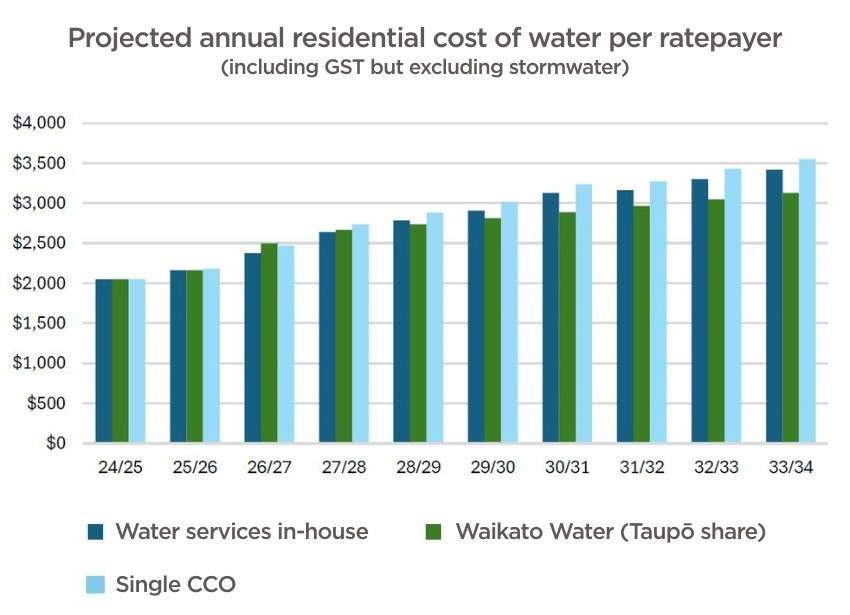
The average residential charge for water over the next five years is similar between Option One and Option Two. After ten years Waikato Water modelling projects rates savings of approximately 10%, however this saving is based on efficiency and borrowing assumptions.
Average charges under Option Three are slightly higher due to higher costs and no expected efficiency gains.
Under Option 2 and 3, Taupō District Council General Rates would be slightly higher, due to the general overheads spread across less revenue. This means, for Options 1 and 2, your water charges combined with your council rates bill will result in a similar total amount to pay.
The average annual residential charge* over the next ten years (including GST and excluding stormwater) for water services is:
- Under Taupō District Council inhouse model (Option One): $2,793
- Under Waikato Water (Option Two): $2,695
- Under Taupō Single CCO (Option Three): $2,883
As a comparison, the average annual residential charge for water services in 2024-25 is $2,049.
*Financial modelling contains uncertainties and requires certain assumptions. The figures quoted above are representative only. They do, however, provide an indication of the level of expected cost increases.
Paying for infrastructure: different choices
Financial strategies vary between organisations and depend on organisational context, including goals, funding needs, ownership, and governance structure. A council financial strategy is defined within the New Zealand Local Government Act 2002, and essentially provides a context for the council's financial decisions and informs the community about how its plan will affect services, rates, debt, and investments.
- Option One: Taupō District Council’s in house business unit will retain Council’s current financial strategy as consulted on with the community through the 2024-34 Long-Term Plan. This financial strategy focuses on maintaining financial prudence and keeping Council’s debt relatively low. Council will consult with the community on whether this approach remains relevant during Council’s next long-term planning process.
- Option Two: Waikato Water modelling uses a different financial strategy, leveraging debt to keep water charges more affordable. This means the potential water charges could be slightly lower than under our inhouse model, but this is contrasted with the higher debt levels that the CCO will take on. Under the joint CCO model, Taupō District Council will need to guarantee a share of this debt and any other capital requirements of the CCO, through a call on capital over Council assets. Over time, it is forecast that efficiencies will be gained from the jointly owned CCO and lead to some cost savings for water customers, however the payback period for these efficiencies is estimated at nine years.
- Option Three: The single CCO model charges will be higher than Option One, given the additional costs and roles required to support the separation (such as separate board and management), with no offsetting efficiency savings in a single owned CCO. Debt remains similar to the in house business unit as no assumption has been made on any appetite to move away from Council’s current financial strategy.
Summary
- Our current strategy can be likened to paying down your mortgage faster to save interest costs over time.
- An alternative strategy can be likened to stretching your mortgage out over a longer period – you will pay less each month, but you will end up paying more in interest over the long term. These are choices.
- Historically our council has taken a financially prudent approach and focused on keeping debt relatively low, paying our own way, and ensuring we aren’t putting burden on future generations. The community has been key in guiding this approach.
- Under either model, Council could choose to take an alternative approach and amend its financial strategy to change the balance of rates affordability and debt. However, under the Waikato model, Council and our community will have less influence on this decision as a minority shareholder.
Debt impact
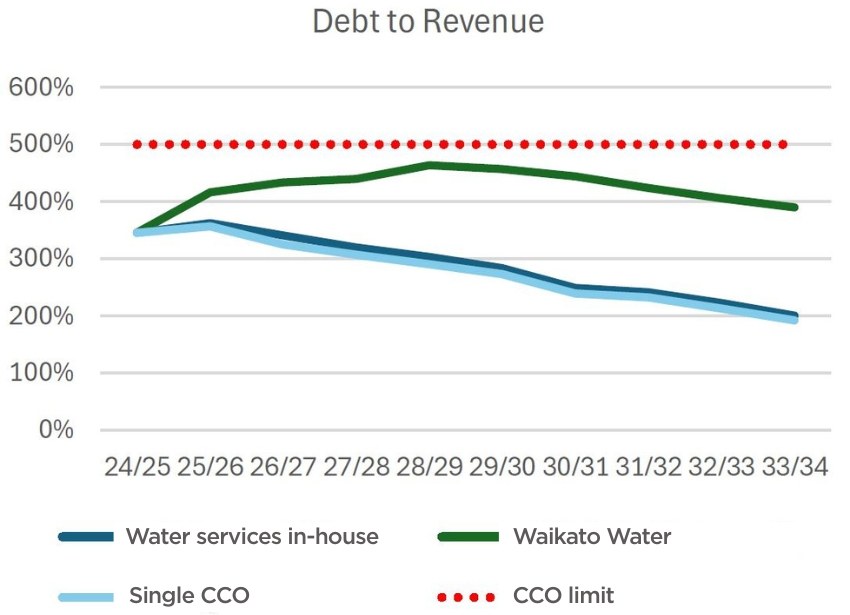
Taupō District Council’s financial strategy as per our Long Term Plan 2024-2034, ensures Council doesn't burden future generations by keeping debt low.
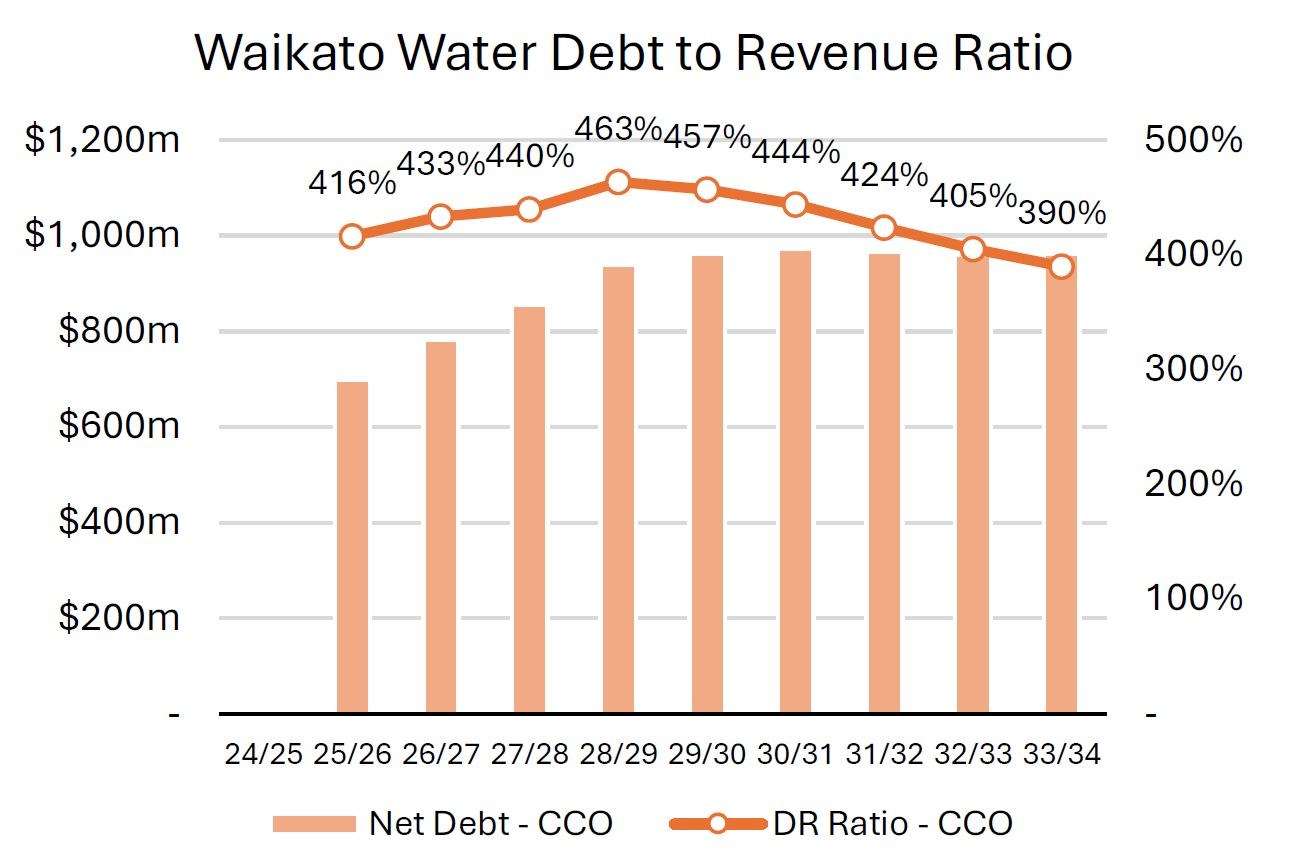
Waikato Water modelling uses a different financial strategy, leveraging debt to keep rates more affordable. Taupō District Council will need to guarantee its share of this higher debt level.
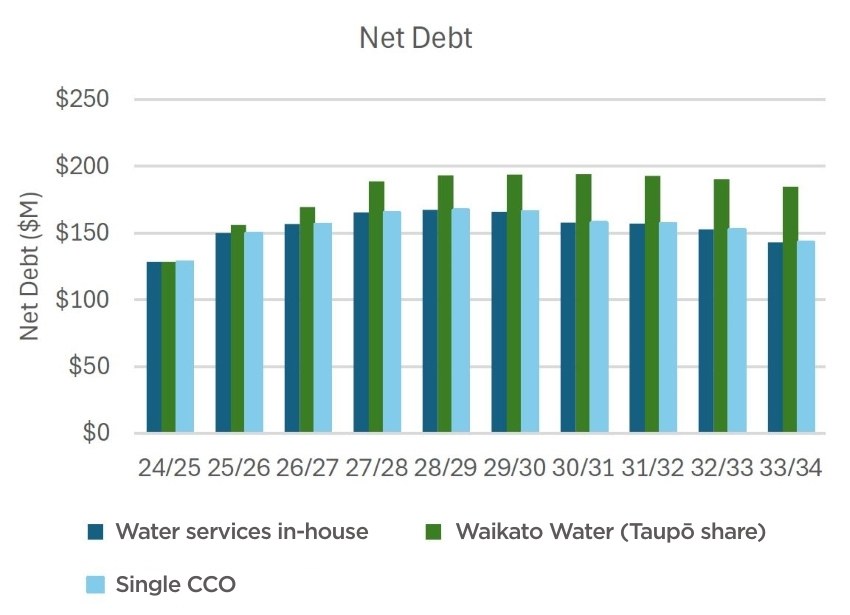
Initial modelling for Waikato assumes no cross-subsidisation / harmonisation. However it is possible this will be challenged over time and under this plausible scenario, we would be guaranteeing a significantly higher share of the water entities debt than shown above, if we end up guaranteeing the debt based on water connections. This could impact on the water charges of the community as well as Taupō District Council’s credit rating, financing costs and ability to borrow for other purposes.